7.19.2016

Rest your little head and tell me about the past - first show at reopened Culture Center in Alingsås

The Culture Center in Alingsås has been closed for renovation for a while; in June it reopened with a remodeled art space and library. There are sadly few art spaces and galleries in the little town of Alingsås, but there are some institutions that have exhibitions with mostly local artists, and I hope that the reopened art gallery at the Culture Center will pursue work like that and maybe open up for international artists. With the new gallery being bigger I hope that more focus can be put on art in Alingsås in the future.

The first exhibition to open in the new space is called Rest your little head and tell me about the past by artist Patrik Bengtsson. Bengtsson is living in the southern archipelago of Gothenburg and has had exhibitions in Sweden and Europe. The exhibition is composed of three different parts, and it might even be accurate to call the work an installation. The most prominent part of the exhibition is the 1:1 scale Brontosaurus sculpture made out of fabric that is laying on the ground with a big fluffy pillow under its head. The wall to the right of the Brontosaurus is decorated with a motif from space, and on the other wall to the left is a kind of speaker-system installed. The sound coming from the round speakers is a sort of low humming which really sets the mood in the gallery. Behind the same wall is a sort of mini-installation with different materials in a pattern.

The life-size Brontosaurus by artist Patrik Bengtsson. Photo: Frida Berntson

The sign reads "Be careful, the sculpture is fragile, but gentle petting is okay." Photo: Frida Berntson

Bengtsson’s installation is about history, truth and storytelling. The Brontosaurus is signifying all of that with its existence being questioned and the story of its origin being changed throughout the past centuries. The humming sound from the speakers is actually re-edited famous speeches from youtube videos. You start to contemplate the very concept of time after a while, the contrast between the Brontosaurus and speeches of politicians is stark. You also realize that it is important to sometimes stop and think about the truths of the past, which I think is the main message of the entire exhibition.

The information that was provided on the wall at the exhibition. Photo: Frida Berntson

Wall installation by Patrik Bengtsson. Photo: Frida Berntson

The wall with the speakers. Photo: Frida Berntson


The exhibition was dynamic with the focus on space and form, but I can’t deny the lack of information that was provided by the gallery. A paragraph of text was placed on the wall but the information was vague and nothing was said about the artist, style influences, materials or anything like that. For an exhibition with this type of existential theme I think it would be necessary with enough information so the visitor can move around the installation and understand the pattern. When I was walking around the space I was a little confused, wondering what everything really meant. There were some papers with more information at the venue but it was organized as long essays, which is not that approachable for the average viewer. I did really like the sign in front of the Brontosaurus though, and the exhibition is excellent for children. Of course you can make the installation your own, without information, but since the artist had a special message I think more accessible information should have been provided.


You can find information about the new Culture Center and exhibition here, sadly only in Swedish.

5.01.2016

Art and Media Activism in the Bay Area

Information at the entrance of Take This Hammer at the YBCA. Photo: Frida Berntson, April 24, 2016.

Art and activism; two concepts that often go hand in hand in today’s art world, it’s hard to even think of art that isn’t in some way politically or socially loaded. So what does art activism look like today? And how has activism changed with social media, huge corporations, hashtags and profile pictures? These questions and more are covered in the exhibition Take This Hammer – Art + Media Activism from the Bay Area currently open at the Yerba Buena Center for the Arts in San Francisco.

The curator of the show, Christian L. Frock, is an independent curator, writer and educator and focuses her work on art and politics. In the very informative show brochure Deborah Cullinan, CEO, talks about how the mission of YBCA is to express culture that moves people, and that cultural movement is the essential element for change. Take This Hammer really expresses that statement; as a voice of the people.

The Exhibition space of Take This Hammer at the YBCA. Photo: Frida Berntson, April 24, 2016

The exhibition space was large and open, with smaller rooms and a big central room for bigger works. The first thing you see when entering the exhibition is a huge installation of posters by the graphic arts collaboration Dignidad Rebelde. Their prints are about Chicana feminism and indigenous people’s rights to confront power. Every poster declared an issue and a call for action. My favorite poster was one that declared how Oakland is occupied land and belongs to the Ohlone Native Americans. I can relate to this a little bit since I wrote a research paper about the Ohlone people in a history of California class that I took at Santa Monica College. I think anyone can relate in some way to any of the posters.

Dignidad Rebelde, Selected works, 2007-15, seventy screen prints, fifteen digital prints, and one offset print. Photo: Frida Berntson, April 24, 2016.

Detail, Dignidad Rebelde, Selected works, 2007-15, seventy screen prints, fifteen digital prints, and one offset print. Photo: Frida Berntson, April 24, 2016.

Some artworks were hard to experience, they showed how exposed Hispanic and African American people are in the Bay Area. They might be victims of possible eviction due to gentrification, or more likely to experience police brutality. The two interactive artworks by the Anti-Eviction Mapping Project showed different maps where you could acquire data about how ethnic groups have moved from different places in the city, how public space has been reduced and data about how many people of different ethnic groups are victims of police brutality by the SFPD and OPD. The artwork is simple but powerful, it is hard to experience this horrible data. One can think that the rational format makes it impersonal, but the added pictures of victims of police brutality make it both personal and real.

Anti-Eviction Mapping Project, Compilation of Maps: Ellis Act Eviction Map, No-Fault Eviction Map, Loss of Public Space Map, Map of Killings by the SFPD and OPD, 2016, Video, color, 24:59 min. Photo: Frida Berntson, April 24, 2016

The whole exhibition is also about social issues of the past, present and future. In one corner of the exhibition was the innovative installation The Guantanamo Bay Museum of Art and History by The Walter Benjamin Memorial Gallery. The installation showed information about a newly opened museum at Guantanamo Bay after it was closed in 2012. You could read on the posters how the museum was dedicated to remembering the awful human rights abuses that took place there and that the institution focused on public discussion. The installation is showing a utopian present where President Obama kept his word and shut down the infamous institution. This artwork shows another present and a future that we maybe can try and accomplish.

The exhibition was very dynamic, with different types of media and showing local artists, all very positive factors. One thing that could have made the experience even better was if the show was more interactive since it was about activism.

The Walter Benjamin Memorial Gallery, The Guantanamo Bay Museum of Art and History, 2016, Mixed-media Installation. Photo: Frida Berntson, April 24, 2016

The Walter Benjamin Memorial Gallery, The Guantanamo Bay Museum of Art and History, 2016, Mixed-media Installation. Photo: Frida Berntson, April 24, 2016

Take This Hammer leaves you angry, dejected and even sad; suddenly this world of inequality opens up in front of you through art, which makes the impact even more powerful. But the exhibition also gives you strength and power to change. With artists working with this, inspiring and hoping for a better future, it really catches onto you.

Me in front of the artwork Blackout by Indira Allegra, 2015, Six-channel video, black and white, 1:30 min. Photo: Tone Persdotter, April 24, 2016

4.24.2016

Aftershock – lecture about the Art Hotel with organizers and artists

Art Hotel organizers speaking at the lecture. Photo: Frida Berntson, 042016

Some of you might remember the blog post I did a while back about the ”Art Hotel” in downtown Sacramento. This fantastic happening was probably the strongest art experience I’ve ever had, and I don’t think I’m the only one feeling that. With 13,000 visitors and 20,000 wanting to get in but couldn’t, I think it is safe to say that the Art Hotel was an incredible success! I’m not from Sacramento and not even from the US, but I think I’m on the right track when I think the Art Hotel was probably the most influential art show in Sacramento in years. It has already become legendary. On April 20th Art Hotel organizers Seumas Coutts, Ph.D. and Shaun Burner as well as a few Art Hotel-artists had a lecture at Sac State about the Art Hotel and its impact on Sacramento.

The underlying message during the lecture was how the organizers wanted art to be experienced, they wanted and had free admission; they wanted to achieve total inclusivity, and they wanted the art experience and community to be most important. The Art Hotel created a space where people just experienced art; it wasn’t held in a big institution that could influence the experience, and there wasn’t a “right way” to display the art at the Art Hotel, art was everywhere, unlabeled and raw. This made it feel genuine and artist-to-viewer centered; it turned into a dialogue where the art could speak for itself.

The Art Hotel was also about the major “high culture” institutions versus grassroot organizations. Something Seumas Coutts mentioned a few times is how art is always stressed to be good for the economy, and therefore is accepted to get funded, but what about the thought that art might be good for people, the city? This thought was one of the key elements in the organization of the Art Hotel. They were funded by a kickstarter campaign, and all of the about 130 artists that participated knew that they wouldn’t get any other payment, but they believed in the project and worked together. There was a financial risk, and a risk of failure that everyone was aware of, but every single artist and organizer worked hard to make this happen and to get the word out. The Art Hotel turned into an art community, an art community that almost every artist at the lecture thought was really needed in Sacramento. Many of them mentioned how the art community and the different institutions are competing with each other more than collaborating, and the need to change that.

A moving story that one of the artists told us about was how a single-mother with three kids came to see the show from Folsom (suburb of Sacramento), and that with a possible admission fee, she would probably not have been able to attend the show. This was something that the organizers were very passionate about. Art should be accessible to everyone, no matter what situation or occupation you might have. This is a discussion we have had in Sweden for a long time. It is generally very cheap to visit museums in Sweden, but the fees has gone up in recent years, and I think this can function as a reminder for us to stick with our values and keep the museums accessible for everyone! Right now museums in Gothenburg are free until you’re 25 years old, everyone else can buy a ticket for $5 that is valid for a year and you get free access to all public museums in Gothenburg.

The group responsible for the Art Hotel; M5 Arts, is now planning their next project which is going to be a lot bigger. According to Seumas Coutts they will open the first Sacramento Biennale in 2017. I will probably not be here then, which makes me very sad. But I will take the incredible inspiration with me back to Gothenburg, and I think that something like the Art Hotel could absolutely be made in Gothenburg. Gothenburgians; what do you think?

4.17.2016

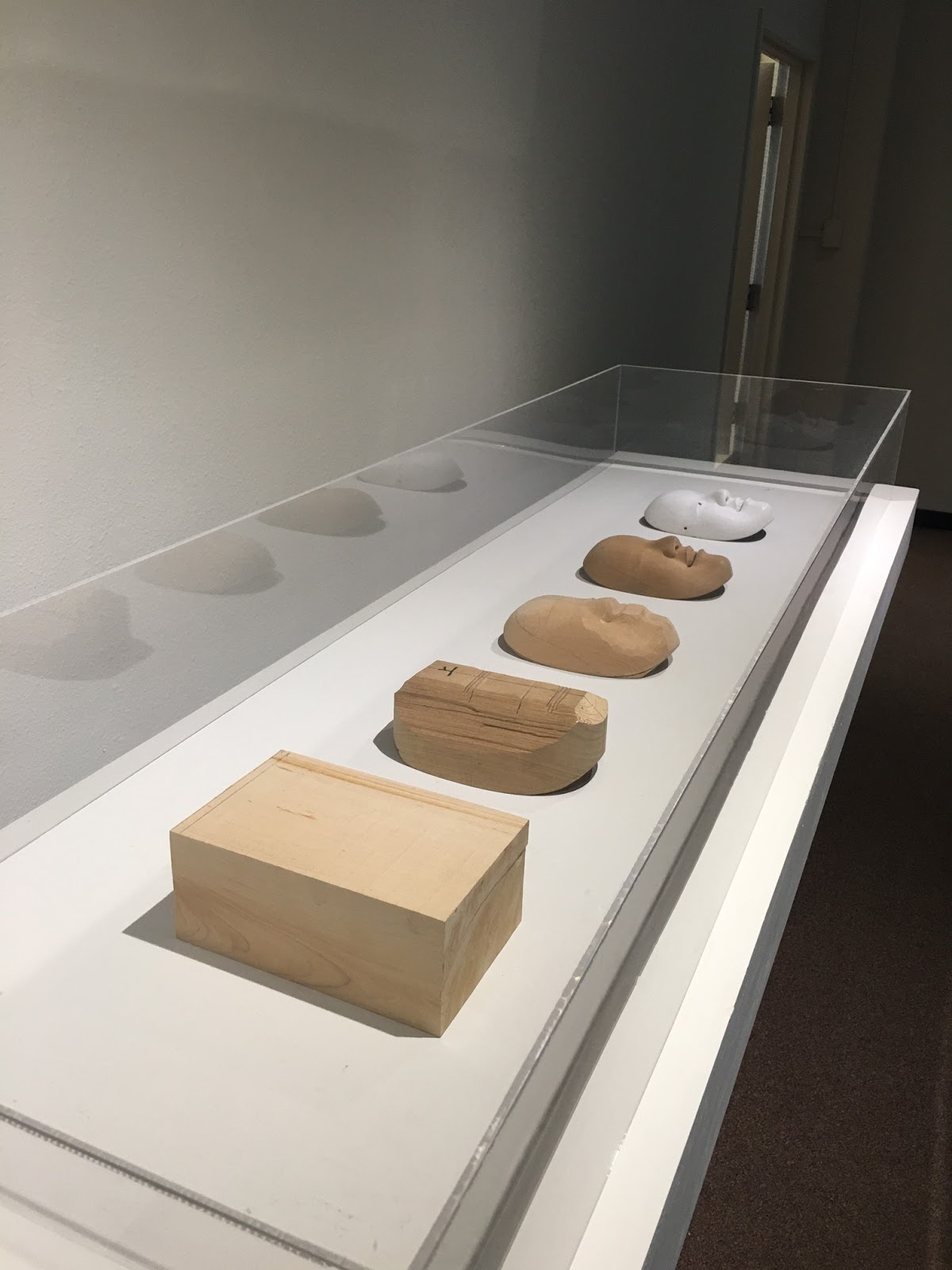
Lecture at Sac State with curator Kendall H. Brown about Bidou Yamaguchi's Noh Masks

Traditional Noh masks by Bidou Yamaguchi. Photo: Frida Berntson, 04-13-16 

The Japanese Noh theater is a traditional theater in Japanese culture heavy with poem, includes music and dance and the stories are mainly about people seeing and dealing with ghosts from the past. Noh theater has been performed since the 14th century. Traditional costumes are worn by the actors as well as masks; specific masks that have a special look to them. Bidou Yamaguchi is one of few contemporary masters of mask carving in Japan, and he is also a pioneer since he is the first artist to go beyond the traditional norm and create non-traditional Noh masks. His masks are currently on display in the Sac State Library Gallery in the exhibition “Traditions Transfigured – The Noh Masks of Bidou Yamaguchi”, and on April 13 a lecture was held there with the curator Prof. Kendall H. Brown of California State University Long Beach.

Kendall H. Brown speaking, beside him the mask of Mona Lisa. Photo: Frida Berntson, 04-13-16

The curator started the lecture by telling the story of how the exhibition was made, which I thought was interesting. The exhibition was made in collaboration with graduate students at Cal State Long Beach, and the show was specifically done for universities. The exhibition had a lot of different elements like video, sound and an interactive part which the curator explained was the student’s idea. The interactive part consisted of a mirror and “toy” Noh masks that you could handle yourself and maybe take a “selfie”, which the curator thought was very amusing but also a great idea.

Mask depicting Vermeer's Girl with a Pearl Earring by Bidou Yamaguchi. Photo: Frida Berntson, 04-13-16
Mask depicting Munch's Madonna by Bidou Yamaguchi. Photo: Frida Berntson, 04-13-16

The exhibition was done in three parts; the first part with traditional masks and the art that inspired them, the second part with the new non-traditional masks, and the last and third part about the making of the masks. The first part is Yamaguchi’s day job, Brown explained. For several hundred years no new masks were made in Japan, the actors just kept using the traditional old ones. But of course that wasn’t sustainable, so new masks started to be made, and the new carvers copied the old masks. This can seem uncreative and boring to westerners, but Asia has a tradition of copying old masters, as in Chinese landscape painting for example, everyone copying make subtle changes which lead to new ideas. So the new mask artists learned how to age the masks; add little cracks all over the paint and make it look worn where the actors would hold it. So Noh mask carvers are also masters in aging techniques. One important thing that the curator pointed out is that Noh mask makers are not only carvers but also painters, they carve and paint their objects, so it is a truly dynamic work.

The second part of the exhibition was the most exciting with the new non-traditional masks; Bidou Yamaguchi started a series with famous European portraits of women. Masks of Mona Lisa, Botticelli’s Venus, Vermeer’s Girl with a Pearl Earring and Munch’s Madonna were displayed at the exhibition to name a few. When asked why the artist chose this subject the explanation was that he was simply drawn to their faces. These masks are however not simple appropriations; since the Noh play is about ghosts, the masks are considered to express the ghosts of the women, their spirits and their persona. Yamaguchi even re-created all the little oil paint-cracks that most of these paintings have, and according to the curator it took somewhere between eight to nine hours to create! All masks have the sophistication of the traditional ones, and the artist has expertly re-imagined legendary women of art history from 2D to 3D magic.

The process of carving a Noh mask, by Bidou Yamaguchi. Photo: Frida Berntson, 04-13-16

The third and last part of the exhibition was about the making of the masks and also about how the masks appear in different angles and light. Brown explained that the traditional mask “young lady” actually appears to change its expression in different angles and light. There was a video showing this where a robot turned the mask in different ways, and we could all see how the mask turned slightly sad, a little angry, or happy when the smile was accentuated.

The lecture was a very positive experience, the audience walked around in the exhibition and the curator talked about the different parts as we walked through it which is a different format than just sitting down before a slideshow. It is a very good format, it keeps your interest up and you are engaged in the art at the same time you learn everything about it.

The exhibition is on display at Sac State until May 21, 2016.

A video showing the masks from the Sac State Youtube channel.

4.03.2016

Art at Elliott Fouts Gallery

Sacramento has a large number of art galleries across the city, and many of them reside in the lively area of Midtown. Next to downtown, Midtown with its many restaurants, bars and graffiti murals amongst charming wooden houses and lots of trees is a dynamic and interesting neighborhood. No doubt galleries find this area exciting. Elliott Fouts Gallery, one of the galleries in Midtown, opened in 1999 but moved to Midtown in 2012. The gallery specializes in representational landscape and still life painting and has an exhibition space with monthly shows as well as a bigger area for the regular works for sale. Since the gallery was in the midst of changing exhibitions I saw a small portion of Timothy Mulligan’s work that was up in one part of the gallery, and the brand new exhibition of paintings by Lauren Pretorius in the main exhibition space.

Me in front of Timothy Mulligans art. Photo: Virginie, 04-02-16

Timothy Mulligan, Coastal Cliff View, Northern CA, 2015, acrylic on canvas. Photo: Frida Berntson, 04-02-16

Timothy Mulligan, Lake Boats, Tahoe, 2015, acrylic on canvas. Photo: Frida Berntson, 04-02-16

Detail from Timothy Mulligan, Lake Boats, Tahoe, 2015, acrylic on canvas. Photo: Frida Berntson, 04-02-16

Timothy Mulligan, Tiscornia Park, Sacramento, 2015, acrylic on canvas. Photo: Frida Berntson, 04-02-16


Timothy Mulligan’s work is essentially inspired by the French Impressionist movement but with elements of a more expressive style with simplified forms and clear, crisp colors. At first glance Mulligan’s art comes across as very colorful but maybe a little lifeless and overly structured with diagonals and lines crossing perfectly on the canvas. But as you look closely his paintings express a sharp texture that suits very well with the overall style, and the use of different techniques as etching into the wet paint and the absence of visible brushstrokes makes the paintings come together as a whole. Mulligan is a local artist educated at Sacramento State, and his motifs are landscapes around Sacramento and the Bay Area. In Sweden artists paint local landscapes in a very specific way to express the clear and kind of cold Scandinavian light, and to compare that to Mulligan’s warm toned Californian landscape was very interesting.


Lauren Pretorius's exhibition at Elloitt Fouts Gallery. Photo: Frida Berntson, 04-02-16

Lauren Pretorius, Cracked Egg, oil on panel. Photo: Frida Berntson, 04-02-16

Detail of Lauren Pretorius, PB&J Sandwich, oil on panel. Photo: Frida Berntson, 04-02-16

Lauren Pretorius, Spoonful of Honey, oil on panel. Photo: Frida Berntson, 04-02-16

Lauren Pretorius, Fresh Lemonade, oil on panel. Photo; Frida Berntson, 04-02-16


Lauren Pretorius’s show in the exhibition space was very different from Timothy Mulligan’s art. Pretorius’s work is in the still life tradition but with a modern twist with smaller square or rectangular canvases with different objects from everyday life; chopped vegetables, a cracked egg, a glass of lemonade, an onion, an avocado and my favorite – a peanut butter and jelly sandwich. The objects are beautifully modeled in a realistic manner in light and shadow. My initial thoughts from Pretorius’s art was that it is kind of dissecting the mundane in our lives and analyzing the objects we are so familiar with that we don’t notice them. For me as a foreigner some of the paintings made me think of the typical American daily life; especially the paintings with the lemonade, the honey bear, and the peanut butter and jelly sandwich. But for Americans it is probably just a depiction of mundane things.


It is interesting comparing galleries and museums; museums often have an admission fee, but you feel almost always welcome there, at this particular gallery you did not feel welcome at all, even though you didn’t have to pay to see the art. Maybe you could describe this situation as what type of space is welcoming you, a public space or private? 

3.14.2016

Ai Weiwei at the Crocker Museum in Sacramento

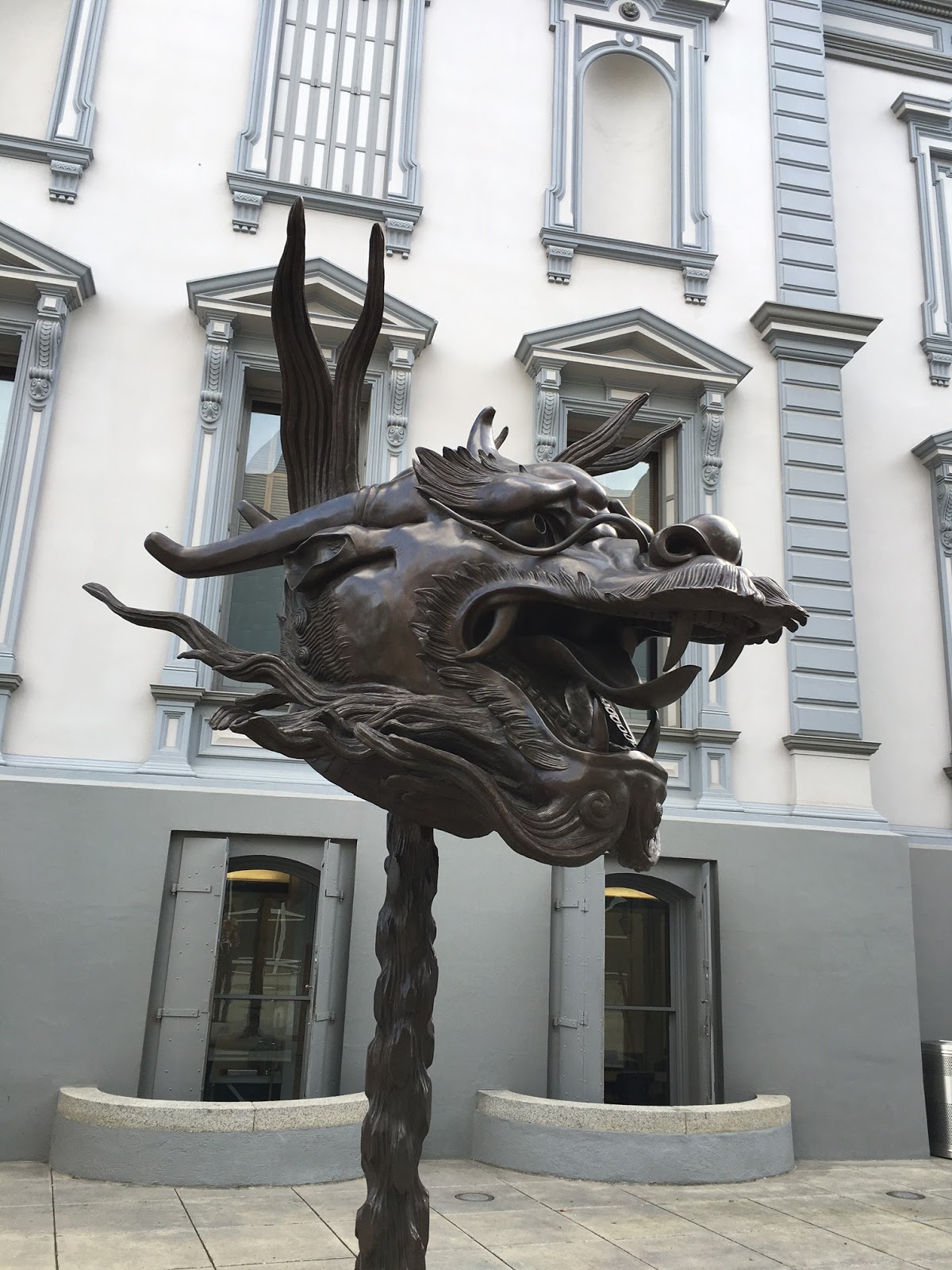
Ai Weiwei, Circle of Animals, Zodiac Heads, bronze, 2010, installation at the Crocker 2016. Photo: Frida Berntson, 03-06-16

Few people interested in the contemporary art world today are unaware of the Chinese artist Ai Weiwei. As an artist, architect, sculptor and activist Ai Weiwei encapsulates the super active media society that we live in today. His political work and gripping installations have made him probably the best known artist of our time, and to see his work on display at the Crocker Museum in Sacramento was truly exciting, almost like seeing a celebrity. The fame of Ai Weiwei makes the experience of his work even more interesting but also problematic; do we see his art differently because he is so critically acclaimed? All his work may not be celebrated, but the large shadow of fame must certainly creep into our conscience as we find ourselves in his art.

Ai Weiwei, Circle of Animals, Zodiac Heads, bronze, 2010, installation at the Crocker 2016. Photo: Frida Berntson, 03-06-16

Ai Weiwei, Circle of Animals, Zodiac Heads, bronze, 2010, installation at the Crocker 2016. Photo: Frida Berntson, 03-06-16

The Crocker is showing Ai Weiwei’s installation Circle of Animals, Zodiac Heads right now until May 12016. The artwork consists of the twelve Chinese zodiac animals' heads cast in bronze in an oversized scale. They stand in a circle just outside the entrance at the Crocker, looming before anyone who stands before them. The size of the heads gives a massive impression, but each one is sculpted differently. Some of them look rather naïve, especially the rabbit and monkey. The ram, rooster and dog are on the other hand sculpted very naturalistically, some even with fine veins on the surface of the heavy bronze. Some of the animals are stylized; the tiger and especially the dragon. The dragon catches your eye fast, because of its specifically Chinese style, it is as if it screams for attention… or it might just be different from the other ones.

Ai Weiwei, Circle of Animals, Zodiac Heads, bronze, 2010, installation at the Crocker 2016. Photo: Frida Berntson, 03-06-16

Ai Weiwei, Detail of Circle of Animals, Zodiac Heads, bronze, 2010, installation at the Crocker 2016. Photo: Frida Berntson, 03-06-16

There is no doubt that this work draws attention to Chinese history, art and Chinese identity, topics that Ai Weiwei has touched on many times. The heads are actually inspired by the twelve zodiac animal heads that adorned the 18th century fountain-clock of the Yuanming Yuan; an imperial retreat close to Beijing. The Yuanming Yuan was sacked by French and British troops in 1860 and the heads were lost. Ai Weiwei’s contemporary recreation of the heads can be interpreted as a sort of ceremonial repatriation. One could think that the culture of China is more and more westernized each year with the expanding economy and sort of western way of society spreading throughout the country. Maybe Ai Weiwei is reacting to change in his artwork or questioning the establishment? Maybe the dragon represents traditional Chinese culture; a large shadow over the other animals and a bit lonely. The artist is above all reflecting over what it means to be Chinese today, in recreating an old legend in this specific way.

Me in front of Ai Weiwei's Circle of Animals, Zodiac Heads, bronze, 2010, installation at the Crocker 2016. Photo: Virginie, 03-06-16

The exhibition was a good experience and I think the Crocker had done a nice job in how to complement the monumental bronze heads. They had a good text next to the objects, not too long and not too short. The text was also friendly to people that may not have been familiar with Ai Weiwei, which is nice in terms of participation. There was a bigger room and area with more information inside the museum, and sometimes too much context can ruin an art experience but I think it really fitted well here. A weakness in the exhibition is that it is spread out at the museum; it was hard finding the way to the additional information area and without exploring through the museum it can easily be missed. Maybe this is not Ai Weiwei’s most jaw dropping or loud artwork, but it has other qualities; it is a quiet ponder about China, its people and fast-forward change.


Information about the exhibition on the Crocker website click here

3.05.2016

Pump up the volume! – review of the exhibition with artists Joe Lewis and Jane Dickson

A couple of weeks ago I wrote about the exciting artists’ talk that was held at Sac State with artists Joe Lewis and Jane Dickson as a part of their exhibition “Pump up the Volume!”, and it is time to talk about their exhibition more closely, even though I am a little late to the party!

If you read my post about the artists’ talk you know the background of Jane Dickson and Joe Lewis, but if you haven’t I will briefly go through their background. Both artists were a part of the famous art organization Fashion Moda in the Bronx in the 1970’s and 1980’s. They worked in new materials and collaborated with graffiti artists for example, they were the pioneers of new art at the time.

Me in front of the title by Joe Lewis and Jane Dickson, at Else Gallery, 02-23-2016
At the opening of the exhibition on January 27, 2016. Photo: Frida Berntson, 01-27-2016

In the foreground Joe Lewis' “UNITY…Who you calling a bitch?”, Epson UltraChrome K3 ink on Kodak Endura Paper, unique, 2015. Photo: Frida Berntson 01-27-2016


In the exhibition at Else Gallery Joe Lewis and Jane Dickson showed a variety of different works, and all of them connected in some way with early hip hop culture, which they both experienced in the Bronx. Early hip hop was playing in the gallery and set a perfect atmosphere and mixed well with the art, which was very varied; paintings, installations, prints and collages. One of my favorite works was Joe Lewis’ “UNITY…Who you calling a bitch?” from 2015. In this digital collage print we see the classical Nefertiti bust besides a wall of boom boxes, and then the best part; a “Hello my name is” sticker but with the text “who you calling a bitch”, put directly on the print. I thought the work was very funny but also a bit political with the classical Nefertiti. It made me think of African American culture, how it has changed and what it means. The Nefertiti bust has always been an art historical ideal, but here she has more of a personality and attitude!

Joe Lewis, The Word, 2010 with visitors in the background. Photo: Frida Berntson 01-27-2016


Jane Dickson had a lot of portraiture in her sketchy and full painting style, which I thought suited well with the hip hop theme. Another of my favorite works was Joe Lewis’ “The Word”, an installation piece set up in the middle of the gallery. It consisted of a table with a white linen cloth and a large open book on top of it, on the page was “THE N WORD” typed, and in front of the table a music-stand. This work made me think of a lot of things and I thought it was remarkable. The thing I remember the most was that I thought it had a lot to do with power, who has the right to speak, to learn, to be educated? And I of course thought about the power of that specific word, where is it now and will it sometime be forgotten?

The exhibition had little or no weaknesses in my opinion; it was very well put together and the relaxed atmosphere made the exhibition less formal. The show was dynamic, interesting, exciting, funny and serious; a nearly perfect display.

Left: Joe Lewis, The Message, Epson UltraChrome K3 ink on Hahnemühle paper, Edition of 3, 2015, right: Jane Dickson, B-Boy Head Spin 1-3, oil on rolotex on canvas, 2016. Photo: Frida Berntson 02-23-2016